%202%20(2).png)
Most independent jewelry stores are not using a dedicated CRM. They are using their POS system's basic customer tracking, a shared spreadsheet, handwritten notes from their best associate, and a little bit of hope.
That works until someone leaves, a customer slips away between visits, or the owner realizes they have no idea which clients have not been contacted in six months. At that point, the question becomes: what should we actually be using?
Here is an honest look at what independent jewelers are using today, what is working, and how to choose the right fit for your store.
What Is a Jewelry CRM?
A jewelry CRM is software that helps independent stores track client relationships, automate follow-up, and drive repeat business. The best platforms go beyond storing contact information. They integrate with your POS, surface which clients need outreach and why, and give associates the tools to build relationships that bring customers back year after year.
This is different from a generic business CRM. Jewelry retail has specific data needs, including ring sizes, metal preferences, repair history, anniversary dates, and wishlist items, that general platforms require manual configuration to handle.
The Reality: Most Jewelers Are Still Piecing It Together
Roughly 65 percent of mid-sized jewelry retailers use some form of integrated POS and inventory management, but only a fraction are using its CRM features consistently. The Edge is one of the most widely used POS systems in the industry and includes basic customer tracking, but most store owners find it limited for follow-up automation, personalized messaging, and associate-level accountability.
Lightspeed, Shopify POS, and Jewel360 face the same gap. These systems are built around transactions, not relationships. The data is there. The tools to act on it are not.
The result is a pattern most jewelry store owners recognize: star associates follow up, everyone else does not, and the store's client relationships live on personal phones rather than in a system the store owns.
Jewelry-Specific CRM and Clienteling Platforms
Clientbook
Clientbook is the leading clienteling platform built exclusively for jewelry retail. It replaces the paper client book with a digital system that integrates natively with The Edge, Jewel360, RAIN/ASC, Lightspeed, and Shopify POS. Customer data, purchase history, and product information sync automatically.
What sets it apart from other options:
The Today page tells every associate who to contact, whose birthday is coming, which sales opportunities are going cold, and which clients have not been in for 90 days. No manager needs to run reports. No associate needs to decide who to call. The system tells them.
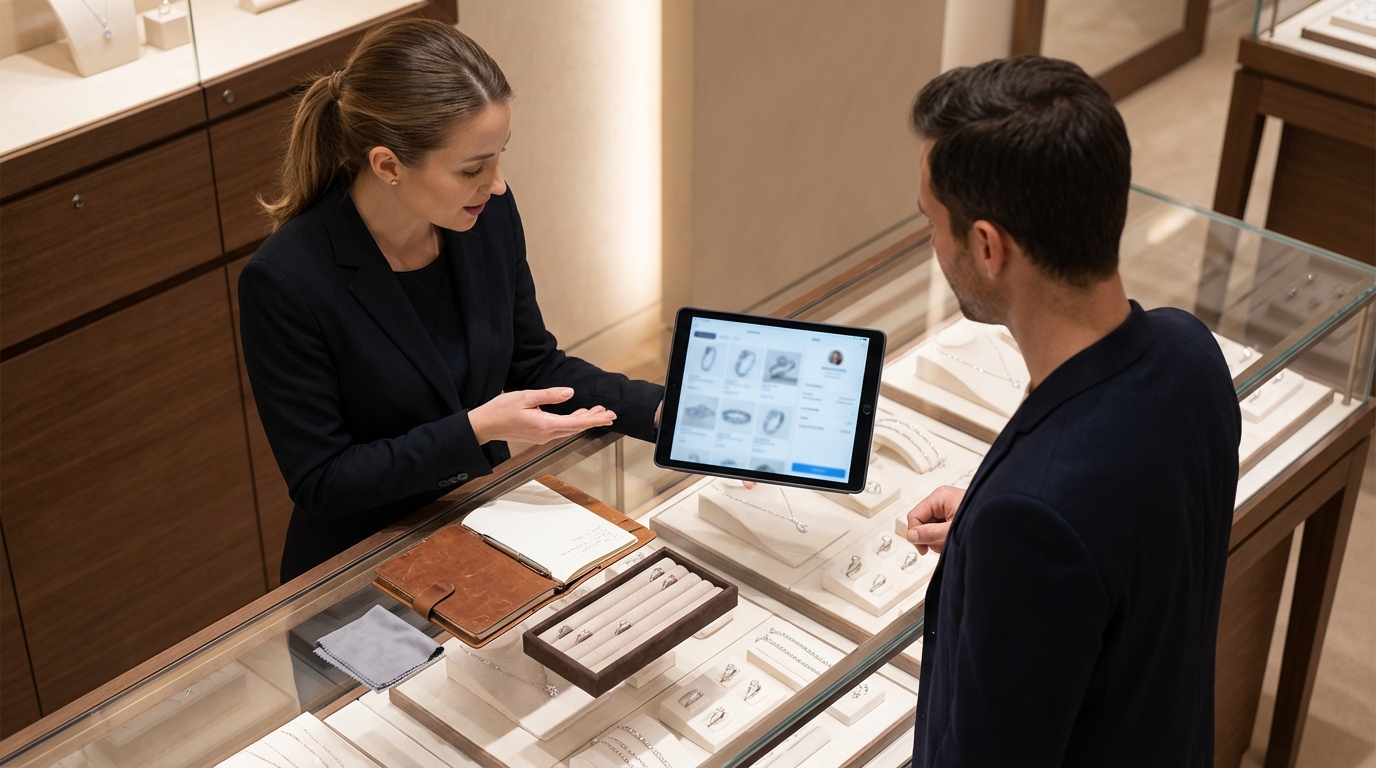
Vendor catalog integrations let associates browse and text high-quality product images directly from designer catalogs including Tacori and A.JAFFE, straight from the app. AI-powered product recommendations surface which specific items to share with which clients based on purchase history. No other jewelry CRM offers this capability.
Automated follow-up for birthdays, anniversaries, post-purchase check-ins, and dormant customers runs without your team having to remember any of it.
Proof it works:
- Wilson Diamonds increased contact capture from under 5 percent to 90 percent
- Goodman and Sons covered their full annual subscription cost within the first month
- Adorn saw 54 percent of associates clientele daily, 86 percent at least twice a week
Best for: Independent jewelry retailers who want a purpose-built clienteling system that works on top of their existing POS.
Want to see how Clientbook works for stores like yours? Book a demo at clientbook.com/demo.
Jewel360
Jewel360 is an all-in-one cloud-based platform built specifically for independent jewelry stores. It handles POS, inventory, repairs, appraisals, and customer management from one system. For stores that want to replace their entire tech stack, it is a legitimate option with jewelry-specific workflows built in.
The tradeoff is depth on the clienteling side. Associate-facing mobile tools and AI-powered outreach recommendations are not Jewel360's focus. It is a solid all-in-one for operational management. For driving repeat business through proactive client outreach, a dedicated platform delivers more.
Best for: Stores ready to migrate their full operation to a cloud-based jewelry-specific system.
CaratIQ
CaratIQ is a comprehensive jewelry store management platform with CRM, inventory, and reporting features. It handles detailed customer tracking and client segmentation for targeted marketing. The pricing reflects its full-stack positioning and is best suited for stores ready to invest in replacing their current system.
Like Jewel360, CaratIQ is built around operational management. Customer relationship features are part of a larger suite rather than the primary focus, which affects how deep the clienteling tools go.
Best for: Stores evaluating an all-in-one replacement and willing to migrate their full operation.
General CRMs Adapted for Jewelry
Some independent jewelers, particularly those with e-commerce operations or multiple locations, use general-purpose CRMs configured for jewelry retail. The most common options:
Salesforce is used by luxury jewelry chains and fashion businesses with dedicated IT resources. It is highly customizable and powerful. For most independent jewelers, the cost, implementation time, and ongoing maintenance make it the wrong tool. Robbins Brothers famously moved off Salesforce to Clientbook specifically because they needed a system built for how jewelry retail works.
HubSpot CRM is popular among e-commerce jewelers for its free tier and marketing automation. It is not jewelry-specific, so there are no native POS integrations with The Edge or Jewel360, no repair tracking, and no brand catalog features. You will spend significant time configuring it before it handles jewelry workflows.
Zoho CRM is an affordable starting point with strong customization. Like HubSpot, it requires building jewelry-specific fields and workflows from scratch. For stores that want a free or low-cost entry point and have the time to configure it, it is workable. For stores that want something running immediately, it is not.
What Features Actually Matter for a Jewelry CRM
Deep client profiles. Name and phone number are not enough. The right platform tracks purchase history, metal and gemstone preferences, ring sizes, anniversaries, birthdays, wishlists, and associate notes from every visit.
POS integration. Your CRM needs to pull customer data and purchase history directly from your POS in real time. If your team is entering information twice, they will stop entering it at all.
Automated follow-up. Birthdays, anniversaries, post-purchase check-ins, and dormant-client alerts should trigger automatically. These are the touchpoints that drive repeat business, and they should not depend on someone remembering to send them.
Text messaging, one-to-one and mass. Jewelry customers respond to text. Your platform needs both personalized associate-to-client messaging and mass campaign capability for trunk shows, new collections, and seasonal outreach.
Associate-level attribution. You need to know which associates are building relationships and which ones are not. Attribution tied to specific outreach is what makes coaching possible and ROI visible.
How to Choose the Right CRM for Your Store
Do you need an all-in-one system or just a clienteling layer? If your POS is working, you do not need to replace it. A dedicated clienteling platform adds the relationship tools your POS lacks without requiring a full migration.
How will your team actually use it? The best CRM is the one your associates open every day. If it requires training to navigate, adoption will be low. Mobile-first, intuitive interfaces are not optional for sales floor tools.
What is your biggest follow-up gap? If customers leave and never hear from your store again, automation is the priority. If your team is doing some outreach but lacks context, AI-powered recommendations matter more.
Does it integrate with your specific POS? Confirm the integration is native and real-time, not a batch sync or a workaround. The quality of the integration determines the quality of the data your team works with.
The Bottom Line
Most independent jewelry stores are not yet using a dedicated CRM. They are using their POS system's basic tracking and relying on their best associates to carry the relationship load. That works until it does not.
The jewelers winning the repeat business game are investing in jewelry-specific clienteling platforms that own the client data, automate the follow-up, and give every associate the tools to do what only the best associates currently do.
Clientbook is the clear leader for independent jewelry stores. It is purpose-built for this industry, integrates with the POS systems jewelers actually run, and delivers results that generic CRMs cannot match without months of configuration.
See what it looks like for a store like yours. Book a demo at clientbook.com/demo.
Related reading:
- Want to Succeed at Clienteling? Focus on These Three Essentials
- Is Your Follow-Up Falling Flat? Here's How to Automate It the Right Way
- Why Measuring Sales Associate Performance Is Key for Luxury Retail Success
- Seven Ways AI Can Improve Client Communication for Jewelers