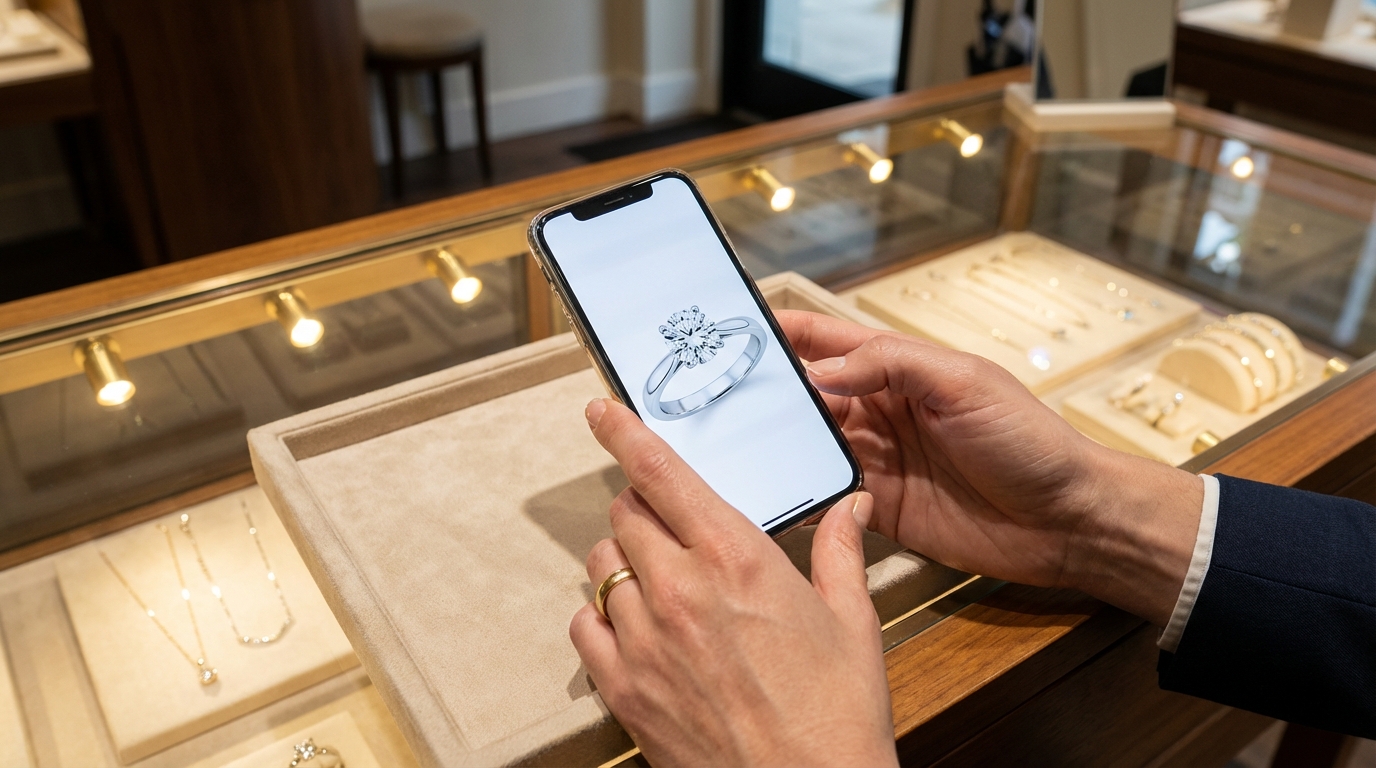

Jewelry is a visual business. Customers need to see the sparkle, the setting, the way a stone catches light before they decide. And increasingly, they want to see it on their phones before they ever walk into your store.
The stores winning that moment are the ones whose associates can text a high-quality product image, from a real brand catalog, in seconds. Not a screenshot. Not a fuzzy photo. A professional image that makes the customer want to come in.
Here is what actually works, and what to look for before you commit to a platform.
What Jewelry Stores Need From a Visual Selling Tool
Most general SMS platforms support image messaging. That is not the problem. The problem is where the images come from and what happens after you send them.
High-resolution brand catalog access. Your associates should be able to browse real designer catalogs, find the right piece by name or product ID, and send it without downloading files or hunting through shared folders.
POS integration. If the platform does not sync with your existing POS, purchase history and client preferences are not connected to the outreach. You are sending images without context.
Personalization at the associate level. Mass image blasts do not close jewelry sales. One associate texting one client a specific piece tied to her wishlist does.
Automation tied to purchase history. The best platforms surface which products to share and when, based on what a customer has already bought or browsed.
How to Send Customers High-Quality Product Photos From Your Brand Partners
If you want to send customers high-quality product photos from your brand partners, the practical answer for a jewelry store is to stop sourcing individual image files and start sourcing catalogs. In Clientbook, an enrolled brand catalog is loaded into the platform itself, so the associate texts the brand's own catalog image straight from the product page instead of pulling a file off a retailer asset portal or photographing the piece through the case glass.
Where the images come from. Once a brand catalog is enabled on your account, your team has access to that brand's inventory along with its high-quality images. Associates find a piece by searching the product name or the product ID in the Products tab, on the dashboard or in the mobile app. Any vendor catalogs you have enabled appear in the left-hand column, directly below your own inventory options.
How an associate finds one and sends it. Open the product, then use the message icon in the top right corner of the product page. Search for and select the client, then hit send. From that same product page an associate can also add the piece to the client's wishlist or collection, or open the full details like SKU and product type. One thing to know before you train the floor on it: the share option only appears for products that have images attached.
Why the quality holds up. The file leaving your store is the brand's own asset, produced by the brand for its catalog, not a phone photo taken through glass under showcase lighting. Nobody is resizing anything, renaming anything, or hunting through a shared drive for last season's folder. That matters more in jewelry than in almost any other category, because the decision is being made on a screen before the customer ever sees the piece in person. Here is why high-quality product images matter even for in-store retailers.
What the customer sees. A text from your store, from the associate she has worked with, with the piece in it. No login, no download, no gallery link to open on a laptop later. Wilson Diamonds sees a 98 percent read rate on messages and over 71 percent response rate, which is the honest argument for putting a good image inside a text rather than inside an email nobody opens.
The Questions Associates Ask Before They Start Sending
Which brands can we get? Clientbook's Vendor Integration documentation names Tacori and A.JAFFE as catalogs stores can opt into. The current list, and enrollment itself, runs through your Client Success Manager or the Clientbook team rather than a self-serve setting, so that is a question for onboarding. Enrolling is free, and the feature is only available if your account includes a point of sale integration. See the full list of supported jewelry store POS systems.
Can we send more than one piece at a time? Yes. Images can be attached to an individual message, a mass message, or a template. Supported file types are PNG, JPG, and GIF. The total size of all images in one message cannot exceed 5MB, and each individual image must be no larger than 1.5MB.
Does the send show up on the client record? Sharing from a product page means choosing a specific client, so the image goes out inside that client's conversation rather than as an anonymous broadcast. Associates can log the interaction on the client's Activity tab as well, attaching images or a PDF to the note, and managers can see how often clients are being contacted using the Client Contacts report.
The Best Tools for Sharing Brand Catalog Images in Jewelry Retail
1. Clientbook (Best for Jewelry Stores)
Among the platforms on this list, Clientbook is the one with native brand catalog integrations built specifically for jewelry retail. The Vendor Integration program gives associates direct access to designer catalogs, currently Tacori and A.JAFFE, from inside the Clientbook dashboard and mobile app, with no additional cost to enroll.
How the catalog feature works. Once a brand catalog is enabled, associates can search by product name or product ID inside the Products tab. When they find the right piece, three quick actions are available from that product page: add it to a customer's wishlist or collection, share it directly with a client via text, or pull up full product details including SKU and product type. No downloading, no file management. The Vendor Catalog Overview in the Clientbook help center covers the full details.
AI-powered product recommendations. The platform does more than give associates access to images. It tells them which images to send. If a customer's recent purchase matches items in a vendor catalog, Clientbook surfaces specific product recommendations automatically in the dashboard and mobile app. Associates can review the suggested products, select or deselect what to include, and edit the AI-generated message to make it feel personal before sending. The Vendor Insights article in the Clientbook help center explains how the recommendations are built.
Important enrollment notes. The Vendor Integration program requires an active POS integration on your account. Enrollment is free. Stores carrying Tacori or A.JAFFE can opt in by asking your Clientbook CSM to enroll the store, who can also share the full FAQ on enrollment and data sharing.
What data is shared with vendors. When you opt in, Clientbook shares aggregated activity data: which vendor items associates viewed, which were suggested via AI, which were sent to clients, and which resulted in sales. No personal customer data is shared with vendors.
The broader clienteling context. Brand catalog image sharing is one feature inside a complete clienteling system. Clientbook also integrates natively with The Edge, Jewel360, RAIN/ASC, Lightspeed, Shopify POS, and Logicmate, and reaches many more jewelry systems through the BIG bridge. The Today page surfaces which clients to contact and why. Automated follow-ups for birthdays, anniversaries, and dormant customers run without your team having to remember them.
Proof it works:
- Wilson Diamonds increased contact capture from under 5 percent to 90 percent
- Goodman and Sons covered their full annual subscription cost within the first month
Best for: Independent jewelry retailers who want native brand catalog access, AI-powered product recommendations, and a complete clienteling system in one platform.
Ready to see the vendor catalog and AI recommendations in action? Book a demo at clientbook.com/demo.
2. Endear
Endear offers a "Lookbook Stories" feature that lets associates curate shoppable product collections and send them via text, email, or WhatsApp. It is a polished format for sharing multiple pieces at once and works well for stores with a strong e-commerce catalog on Shopify.
The gap for jewelry stores is designer catalogs. Endear's integrations page lists point of sale, ecommerce, marketing, support, and customer data tools, and does not list jewelry designer catalogs, so the images you send are your own uploads or your ecommerce catalog's. The platform is also not built around jewelry-specific workflows.
Best for: Omnichannel jewelry retailers with strong Shopify catalogs who want a lookbook-style sharing format.
3. Podium
Podium supports MMS image sending and offers bulk SMS campaigns that can include images and links. Its AI Employee feature handles inbound messages automatically, which is useful for capturing leads outside business hours.
What Podium does not do is tell your associates which products to send to which clients based on purchase history. Image sharing is manual and campaign-based, not recommendation-driven. Its site does not list brand catalog integrations for jewelry designers, or deep connectivity with jewelry-specific point of sale systems.
Best for: Stores that want a general texting and review platform and do not need AI-powered product recommendations or brand catalog access.
4. Tulip
Tulip's Look Builder lets associates create personalized product recommendations and send them via SMS, email, or in-app messaging. It is a strong enterprise clienteling tool with centralized customer data and deep customization.
The limitations for most independent jewelers are cost and complexity. Tulip is built for large multi-location chains with IT resources to manage integrations and ongoing customization. Its site does not list jewelry-specific brand catalog connections either.
Best for: Large multi-location jewelry chains with enterprise budgets and dedicated operations staff.
5. Jewelry-Specific Catalog Tools
A few niche tools focus specifically on jewelry catalog management:
Stuller Showcase is a free digital catalog and quoting tool from Stuller that lets you present and share product images from Stuller's inventory. Stuller presents it as a way to show its own assortment as your own, so it is scoped to Stuller's catalog, and its site does not list clienteling, follow-up automation, or point of sale integration.
JewelCloud by GemFind lets retailers access vendor catalogs and send product information to customers. It is useful for stores working with multiple suppliers who want centralized catalog access, but GemFind's site positions JewelCloud around catalog and product data distribution rather than the associate-level follow-up and client record that drive repeat business.
These tools fill a specific gap in catalog access. They are not clienteling platforms.
Why Generic SMS Tools Fall Short for Jewelry
General SMS marketing platforms like Attentive, Postscript, and Heymarket support MMS and can send images at scale. For broad promotional campaigns, that works fine.
For jewelry clienteling, it does not. A mass text promoting a weekend ring sale is not the same as one associate texting one client a specific Tacori piece that matches what she put on her wishlist six months ago. The difference in conversion is not marginal. It is the entire model.
Jewelry is a relationship business. The tools that drive repeat sales are the ones that know who the customer is, what she has already bought, and what she is likely to want next. That requires POS integration, client profiles, and AI-powered recommendations, not a broadcast marketing tool.
How to Choose the Right Platform
Do you carry Tacori or A.JAFFE? If yes, Clientbook's Vendor Integration program gives your associates direct catalog access at no additional cost. That is a specific, high-value capability, and it is not something a general texting platform is built to do. Review the enrollment FAQ with your Clientbook CSM.
Is your biggest gap finding the right image or sending it? If associates are spending time hunting for product photos, catalog access solves that. If they know what to send but do not know who to send it to, AI-powered recommendations matter more.
Do you have an active POS integration? Clientbook's Vendor Integration requires one. If you are not yet integrated, that is the first step, and it turns on the full feature set including catalog access, AI recommendations, and attributed sales tracking.
Are you an independent store or a large chain? Most independent jewelers will get the best return from Clientbook. Multi-location chains with enterprise budgets may want to evaluate Tulip or Endear for their cross-channel capabilities.
Frequently Asked Questions
How can my jewelry store send customers high-quality product photos from our brand partners?
Use a clienteling platform that carries the brand's catalog natively. In Clientbook, an enabled vendor catalog puts the brand's own high-quality images inside the Products tab, where an associate searches by product name or product ID, opens the piece, taps the message icon, selects the client, and sends. There is no file to download, no shared folder to search, and no reason to photograph the showcase.
Do we need a POS integration to use brand catalogs?
Yes. The Vendor Integration program is currently only available if your account includes a point of sale integration. Enrollment itself is free. If you are not integrated yet, that is the first step, and it also turns on purchase history, product recommendations, and attributed sales tracking. To check whether your system is covered, see the full list of jewelry POS systems Clientbook works with.
What happens to the image quality once the text goes out?
The image leaves Clientbook as the brand's own file. Delivery after that sits with the mobile carriers. Some carriers apply strict size and content policies, so while images deliver to most carriers, there can be delivery exceptions depending on each carrier's own guidelines. Staying inside the supported file types and size limits is the part your team controls.
What are the rules for using a brand's catalog images?
Access is an opt in, arranged through the Vendor Integration program, so any specific usage terms are a question for your Client Success Manager at enrollment. What Clientbook documents is the data that travels back: vendor items associates viewed, items suggested by AI, items sent to clients, and items sold. No personal customer data is shared with vendors.
The Bottom Line
Texting product images is table stakes. The real question is whether your platform knows which images to send, to which clients, and when.
Clientbook is a jewelry clienteling platform with native brand catalog integrations, AI-powered product recommendations, and a complete follow-up system built around how jewelry retail actually works. The Vendor Integration program is free for enrolled stores, requires no additional cost, and adds a direct line between your designer catalogs and your clients' phones.
See how it works for a store like yours. Book a demo at clientbook.com/demo.
Related reading:
- Want to Succeed at Clienteling? Focus on These Three Essentials
- Seven Ways AI Can Improve Client Communication for Jewelers
- Is Your Follow-Up Falling Flat? Here's How to Automate It the Right Way
- Why Bridal and Fashion Jewelry Buyers Need Different Sales Strategies