


%202%20(2).png)
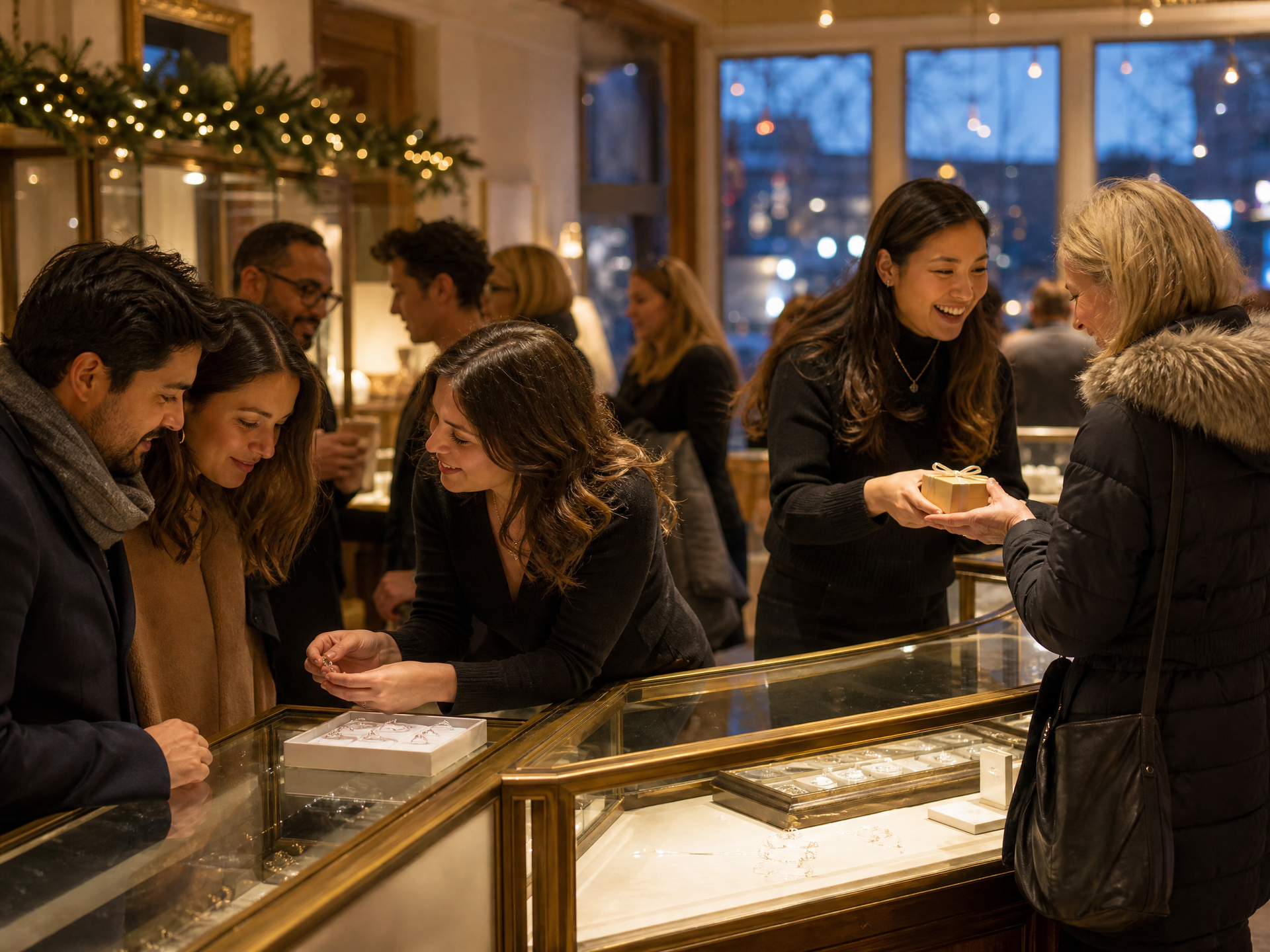
In a jewelry store, the weeks before Christmas are the highest-value selling days of the year and the hardest weeks to do anything other than sell. Both things are true at once, and they compete for the same six or eight people.
Holiday outreach is the work that loses that competition. It has no customer standing in front of it and no manager tapping a watch, so it slides to January. On sales calls, owners describe the pattern almost word for word: best intentions, then too busy to actually do it. One put the alternative plainly, saying he would rather pay someone to reach out for his event than do it himself with another tool.
So the practical question is not whether December outreach is worth doing. It is who does it. There are four realistic answers, each with a real tradeoff, plus a timing problem most stores discover too late.
The December Squeeze
The people best equipped to text your top clients about a holiday event are the same people you need on the floor when the store is full. Personal outreach works because it comes from someone who remembers what a client bought last spring, and that person is almost always your strongest closer. Pulling her into the back office to send messages costs you the sale happening at the counter.
What stores worry about in season is telling. The anxiety is rarely that a campaign underperformed. It is the dropped thread. One multi-store operator escalated an inbox issue three times in eight days during the holidays, writing that with the high volume of customer inquiries it was critical that no customers were missed.
The cost of skipping outreach never shows up on a report. It is the client who would have come in if someone had asked, sitting at home assuming your store is slammed and shopping somewhere easier.
Four Ways to Get Holiday Outreach Done
Split the list across your associates
The cheapest option, and the one most stores default to. Give each associate a slice of the client list and a message template, and let existing relationships do the work. When it lands, it lands well, because the message comes from someone the client already knows. The tradeoffs are consistent: it competes with selling time, so it happens on slow mornings and stops the moment the store fills; coverage comes out uneven, with two or three associates doing most of it; and the replies arrive during peak hours, which is exactly when nobody can answer them. If this is your plan, at least make it efficient: here is how to save your sales team hours of texting before a jewelry store event. For the message templates, our holiday text message templates for jewelry stores give each associate a written starting point for every send of the season, from the event invitation to the January follow-up.
Hire seasonal help
Extra hands in November and December are real relief, and plenty of stores do this well for floor coverage and gift wrap. But outreach is the hardest thing to hand a seasonal hire. A temporary associate does not know which client bought the anniversary band or which couple is shopping for an upgrade. The training cost also lands at the worst moment, since onboarding into your client system happens in November, when November is already full. Seasonal help is a good answer for capacity and a weak one for personal outreach.
Bring in a marketing agency
An agency brings creative capacity and a project manager, useful if you need a campaign concept, holiday photography, and paid media running together. The honest limits: most retail agency work is email-shaped and built for broad audiences, not one-to-one messages that reference a client's purchase history, and most do not handle inbound replies, so the conversation still comes back to your floor. Before signing anything, ask directly: when two hundred customers reply, who answers them, and how fast?
Use a done-for-you service built for jewelry
The fourth option is to hand the whole job to a team that runs jewelry campaigns for a living. That is what Clientbook Concierge does: their team writes the messages, sends them one at a time rather than as a blast, manages every reply, and books appointments back into the store's calendar. Setup takes about fifteen minutes of the store's time. Messages go out from a dedicated campaign number, so opt-outs never touch your main line. Pricing is public and per-campaign: $1 per customer contacted, a $1,000 minimum, and a $250 one-time setup fee waived for existing Clientbook customers. There is no contract and no recurring fee. A non-refundable 20 percent down payment at signup secures the event, and the balance is due the day of the event. See the Concierge pricing page and the Concierge homepage.
December results give a sense of the scale involved. For Herzog Jewelers, a holiday campaign reached 1,853 customers and produced 200 or more replies at a 10.8 percent response rate, roughly twice the usual SMS benchmark, with over 40 appointments booked according to the store's marketing coordinator and zero complaints; the Herzog case study publishes the attribution window. A full sales floor does not absorb that much conversation in December. After a December trunk show, Schmitt Jewelers owner Tom Schmitt said one of the biggest benefits was that it didn't require any time from my team. That sentence is on the Concierge homepage. The Schmitt case study carries his other line, that nobody was annoyed to get it, and the reply record behind the show. Both campaigns are also broken down, attribution windows and buyer mix included, in do holiday text campaigns actually work for jewelry stores.
The year-round version of this comparison lives in our guide to the done-for-you text message marketing service for jewelry stores.
What December Outreach Actually Takes
What makes this hard is not the sending. It is the three jobs around it.
Personalization at volume. A message that reads like a blast performs like a blast. Writing to eighteen hundred people as individuals, referencing what each one bought, is a different task than scheduling one announcement.
Replies at the worst possible hour. A healthy campaign generates hundreds of responses, and they come in while the store is three deep at the case. Unanswered replies are worse than no campaign, because the customer knows you reached out and then went quiet.
Routing a hot lead mid-rush. When someone asks whether you still have the piece she saw in October, that has to reach the right associate immediately, with enough context to be useful. Getting that right is the whole game of filling a jewelry store event with booked appointments.
December Gets Decided in the Fall
Here is the part that catches stores every year. Booking outreach for December is an early autumn decision, not a December one. Events have to be on the calendar before invitations make sense, client lists need cleaning before anyone messages them, and invitations should land while your customers' Decembers still have open evenings. By the time the squeeze is something you can feel on the floor, the window to solve it has closed. The full August to January runway is mapped in how to prepare your jewelry store for the holiday season.
The practical rule: decide who is running holiday outreach at the same time you decide your event dates. If you are reading this in December, run something small now and book the real campaign for next season. Stores that treat events as a repeatable system rather than a scramble tend to make more money from trunk shows and in-store events year over year.
How to Choose: Six Questions
Run whatever option you are weighing, including doing it in house, through the same short list.
Who writes the messages, and do they read like a person or a promotion?
Who answers the replies, during what hours, and how quickly?
Does it use what you know about each client, or send everyone the same text?
What happens to opt-outs? A campaign sent from your main store number can quietly cost you the ability to text a good customer later.
Can you see attributed sales afterward? Knowing whether the event actually worked makes next year's decision easy.
How many hours of your team's December does it consume? Multiply the honest answer by your busiest weekend.
Frequently Asked Questions
Can someone text my customer list about my holiday event for me?
Yes. That is what a done-for-you campaign service does. The distinction worth understanding is between a mass message, one announcement sent to a group from your own system, and a managed campaign, where an outside team writes individual messages, sends them, handles every reply, and books appointments. The first is a tool your staff operates. The second is a job your staff does not have to do.
What if I just want a full store, not a calendar full of appointments?
That is a common and reasonable goal, and owners say it out loud: some only want high attendance on the night. A campaign can be aimed at attendance rather than booked time slots. Say so up front, because it changes how the messages are written.
Will customers be annoyed to get a text in December?
The evidence from December campaigns says no, when the message is personal and relevant. Herzog Jewelers' holiday campaign reached 1,853 customers with zero complaints, and Schmitt Jewelers' owner said of his December campaign that nobody was annoyed to get it. Annoyance comes from irrelevance and frequency, not from the calendar.
How do I make sure my holiday hours show up in my automated replies while we are closed?
In Clientbook, store hours are a setting, including custom hours for days you are closed, and the after-hours auto reply uses that setting to know when the store is closed. The holiday hours do not insert themselves into the message. Write the closure and the hours into the auto-reply text, and do it in November. Christmas Eve is when those requests usually arrive, which is late.
Keep Your Staff on the Floor
December rewards stores that reach out and punishes stores that plan to. The difference is rarely effort or intention. It is whether the outreach belongs to someone whose December is not already full.
See how a done-for-you holiday campaign works at clientbookconcierge.com, or book a walkthrough at clientbook.com/demo.
Related reading:
How to Fill Your Jewelry Store Event with Booked Appointments
How Jewelry Stores Make More Money From Trunk Shows and Events


